Friday, December 7, 2012

Claude Lèvêque

2012 We're a Happy family
Framed embroidery canvas, white neon.
Writing Romantic Etienne


2006 Le Grand Sommeil 
Site- specific installation MAC/VAL Virty- Sur- Senie.
36 PVC bed frames, white polystyrene balls, acrylic hemisphere, Black light.
  

1986 La Fontaine d'argent, le château d'eau, le chemin de fer
Inscription on chair, back removed, profile spotlight projection. 
Collection Mudam Luxembourg

1986 Le Trou dans la tête 
Inscription on cot, dangling light bulb, projection
Collection: FRAC Alsace

2000 Herr Monde
Site- Specific installation, Le Creux de I'enfer, thiers
Crumbled metal sheets, strobe lights

Claude Lèvêque was born in 1958 he is a French artist. He is known to use light in most of his sculptures, especially sense the 80's. Claude has been showing in many solo and group shows. Recently Claude has shifted from light sculptures to giant installations that stimulate the 5 senses through sound, mist, and light. He is currently showing in Art Basel. 


I choose this artist because I saw Claude's 2000 Herr Monde installation. It is my favorite work from him. He does simple things with objects and turns them into something interesting. I like how he uses furniture and turns it into sculpture by changing only a few things. I also think it's amazing how he uses light. He uses light as part of his sculpture instead of using it to show case his work. I also like how he incorporates photographs. I'm kind of going crazy over his work. Okay, okay I am freaking out about his work. I love it

Thursday, December 6, 2012

Evan Robarts

A New Hope (installation). 2011
Bathroom wall mounted vertically in bedroom
dimensions vary
http://evanrobarts.com/post/26027814059/a-new-hope-installation-2011-bathroom-wall

Maturation. 2012
Found Objects, cement
4'x 2'x 3'
http://evanrobarts.com/post/32911754599/maturation-2012-found-object-cement-4-x-2-x


Molecule #3a. 2010
Found objects, foam, rubber bands
Dimensions vary
http://evanrobarts.com/post/26026892458/molecule-3a-2010-found-objects-foam-rubber

Untitled. Basketball 3/3. 2011
Found objects, glass, solder
14" round
http://evanrobarts.com/post/32912363847/untitled-basket-ball-3-3-2011-found-object

View of Molecule #5a. 2010
Found objects, steel threading
Dimensions Vary
http://evanrobarts.com/post/26026613726/view-of-molecule-5a-2010-found-objects-steel

Evan Robarts was born in 1982 and raised in Miami Beach, Florida. Robarts moved to Brooklyn, New York where he went to Pratt institute receiving his BFA in sculpture in 2008.  Evan still lives in Brooklyn where he makes his work. He focuses on the interplay between science and art. He looks for new relationships with materials, form, and identity. Robarts also uses his childhood nostalgia as a platform for his investigations. His work with melted popsicles, bicycles, basketballs, and found objects all tie back to him trying to hold loosely on to his childhood. 

I choose Evan Robarts because his work is interesting to me. My favorite pieces of work by him are Maturation and Untitled. Basketball. I like the way Robarts pulls from his childhood and still incorporates a modern twist. 


 Artists understand things by making while scientists understand things by analyzing the existence patterns in life. With an emphasis on various non traditional materials and found object, he explores these constructs and interface them with the surrounding world.


Wednesday, December 5, 2012

Artist Three: Gian Lorenzo Bernini

Gian Lorenzo Bernini is a great big badass.

LOOK AT THAT
(David, 1623–1624. Marble.)
LOOK AT THIS
(Rape Of Prosperpina, 1622. Marble)
LOOK AT THEM
(Apollo and Daphne, 1622. Marble.)
LOOK AT THAT BUTT
(Borghese Hermaphroditus, 1620. Marble.)
(Okay, technically, Bernini only sculpted the mattress, which is apparently so realistic that thousands upon thousands of visitors attempt to touch it every year)

Gian Lorenzo Bernini was a Baroque sculptor (who also dabbled in poetry, playwriting, painting and architecture). In his sculptures, he specialized in portraying lifelike human figures and dramatic emotion and tension. He was a student of Classical sculpture, who outshined many other sculptors of his time. Bernini was deeply religious-- this is reflected in many of his works involving focus on religious worship or Biblical narrative.

I love Bernini's sculpture because he captures expression fantastically; his sculptures look more human than humans sometimes. He is also a master of the human figure: with The Rape Of Prosperpina, Pluto's fingers dig into Prosperpina's flesh and there are actual marble tears gliding down the side of her face. Impressive, yes. WHAT, HE WAS ONLY TWENTY-THREE YEARS OLD AT THE TIME OF COMPLETION? If that isn't the most radical thing you've ever heard then you are not learning art history properly.

There is only one piece of Bernini's I am less-than-fond of, and that is The Ecstasy Of Saint Theresa, and that is ONLY because there's a great big mass of cloth there that envelops her figure. The cloth is sculpted well, sure, but I would have liked to see Theresa's body. BUT WHAT DO I KNOW BERNINI'S A MADMAN AM I RIGHT

artist 2: Naoko Ito


Naoko ito is a new york based artist. Born in Tokyo, japan, the artist received her Masters at the School of Visual Arts, and was educated at Musashino Art University in Japan where she received her Bachelor of Arts Degree in Science of Design.
She created a four year long series titled “Urban Nature”, where she combined natural and manmade environments/sculptures.

I love the way Naoko Ito used jars to continue an object rather than strictly contain it. The contrast of natural and manmade materials is really breathtaking. If I ever work with preserving animals in the future, or any other wildlife, I may do so in a way more closely inspired by this artist. 


artist 1: Adrian Guerrero


Adrian Guerrero is a multidisciplinary artist born in Guadalajara, Mexico. In 2006 he received his Masters in Ceramics, and studied social sciences as well.  He’s had a great number of exhibitions in galleries through Mexico, Italy, and the Dominican Republic.


I was drawn to the unique presentation of ceramics this artist used. Ceramics are commonly placed on a pedestal due to delicacy, yet Guerrero decided to install his creations on walls and hang his work. I’m fascinated by the simplicity and minimalism in his color choice/ assemblage, and the unconventional display. 


Tuesday, December 4, 2012

Artist #1- Anne Lindberg


Anne Lindberg received her BFA in 1985 from Miami University in Oxford, OH and her MFA in 1988 from the Cranbrook Academy of Art. She has an impressive resume with seven solo exhibitions, 19 group exhibitions and multiple commissions and collections (one at the Kemper Museum of Contemporary Art in Kansas City, MO. Lindberg does thread installations along with graphite, thread, mixed media, photography and 3D wall drawings, as well as installations, sculpture and architectural projects.  She sees her art as a type of self-portraiture.  Lindberg said, "My work is a mirror of how I experience the world and as I negotiate physicality, optics and ideas through drawing languages, my voice withholds, blurs, teases and veils."


I chose Lindberg because I'm intrigued by the use of thread in art.  She uses thread in large scale installations, utilizing light sources to create optical changes in the thread. I absolutely love all of her work because her thread installations are so voluminous and spacious, consuming entire corners of rooms and the lighting creates beautiful patterns and hues.  It's also very textural (especially seen in her work Old Brain).


She describes her installations as states of mind and environment as understood through the body and land.  "They are rooted in the familiar, close to the body, and very personal in connotation and scale."  I could imagine that she shows this in her work because she staples each thread to the wall and all the strands are so close, which imitates her description of the meaning of her work.
Old Brain, 2005. Thread.  650 pounds. 28x5 feet, x 8 inches.
Drawn Pink, 2012. Egyptian cotton thread, staples. 35x6x10 feet.
canto yellow
Canto Yellow, 2011. Egyptian cotton thread, staples. 18x6x6 feet.
Thread Drawing 15, 2012. Rayon thread. 31x28 inches. I'm not quite as fond of her thread drawings, simply because they are flat as opposed to her beautiful 3D room installations.

Websites used: 

  • http://www.annelindberg.com/bio.htm
  • http://www.annelindberg.com/images.htm


Artist Two: BANKSY

BANKSY

"Cardinal Sin", 2011

Not much is known about UK-centered street artist Banksy. He is a mischievous anonymous critter who's works intend to provoke thought or disgust, and are provocative in nature. He works with animatronics, spray paint and stencil, plaster, live animals, taxidermy, fabrics and blow-up dolls--and that's barely scratching the surface.

Banksy has been one of my favorite artists--if not my favorite--for almost five years. I like how he thinks different about the "vandalism" aspect of street art. He recreates famous paintings and sculptures with his own ideas about today's societal norms and installs his work pretty much anywhere (see the second video above for an example at Disney World, which was only left up for about an hour).

Banksy's responsible for some of my favorite quotes about art and life, including:

"People say graffiti is ugly, irresponsible and childish. But that's only if it's done properly."
"Think from outside the box, collapse the box and take a fucking knife to it."
"You can win the rat race but you're still a rat."

Although one of my favorite concepts of his was a gigantic live elephant painted to look like a gallery's wallpaper, the fact that he spray-paints on live animals is a bit disconcerting to me. All in the name of vandalism, I suppose.

Sunday, November 25, 2012

Beth Cavener Stitcher

The Four Humors: The Choleric
Stoneware, mixed media. 2010


Anywhere But Here
Stoneware, antique iron hook, dyed rope, wooden wall pedestal. 2010


i am no one
Stoneware, 2006.


Render
Stoneware, wooden peg. 2009


Husk
Stoneware, wooden box. 2009

all above images/information from http://www.followtheblackrabbit.com/


The Sentimental Question 
Stoneware with ceramic glaze. 2012


The White Hind (The Bride)
Stoneware-based mixed media sculpture, 2012

above images/information taken from http://www.claireoliver.com/artists.html?artist_no=47

Beth Cavener Stitcher was born in Pasadena, California, in 1972, to a molecular biologist and an art teacher. She at first intended to be a scientist like her father, and went to study physics and astronomy at  Haverford College in Pennsylvania. In her senior year, she switched her major to art and earned a BA in sculpture. She builds her massive pieces solid at first, sometimes with thousands of pounds of clay at a time, on steel armatures, and then cuts them into pieces and hollows them out, then reattaches them and cuts them apart again for kiln firing. Her work is based around human psychology, using a simple vocabulary of animals and color along with subtle, delicate nuances to create her poignantly human pieces.

I chose to write about Stitcher because her work is strikingly beautiful. The first piece I saw, A Question that Devours, struck a chord with me in its simplicity and tension. The softness of the surfaces of her pieces is remarkable to me - at once, I can imagine the soft fur that would be there were these animals real and the real, grating texture that the ceramic would have. The slight sexuality of her pieces too, put into animal form, makes her work more uncomfortable to look at than if they were human.


Saturday, November 24, 2012

Cao Hui

Cao Hui 


Visual Temperature - Sofa
Resin, fiber, etc. 2008
http://www.linlingallery.com/eng/artist_work.php?id=33&bb=7&pid=483&currentpage=


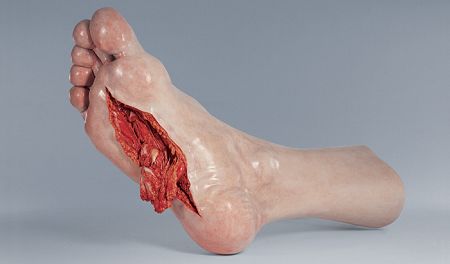
Visual Temperature - Foot
Resin, fiber, etc. 2008
http://www.va-gallery.com/eng/artists/cao-hui/


Unwrap Yourself - Sheep 4
Resin, fiber, etc. 2007
http://www.artnet.com/artwork/426026354/80423/cao-hui-unwrap-yourself---sheep-4.html


Urinals
Cast porcelain. 2001

Cao Hui was born 1968 in Kunming, China, and currently works out of Beijing, China. He has both a Bachelor's and a Master's degree in art and sculpture, respectively, and has served as a lecturer in the Sculpture Department of the Central Academy of Fine Arts in Beijing since 2000. His work is monumental, often life-size or larger, and deals with organic matters: half-flayed animals, inanimate objects made of very animate things, and grotesque, cringe-worthy depictions of our own body parts, but can also deal with humor - Urinals refers to Duchamp's infamous urinal, but was also created to be humorous. 

I chose this artist to write about because his work is difficult to look at. It's hard to imagine sometimes what's inside of ourselves and his work is a look inside of ourselves, and then a look into the darker sides of our everyday world. I like how he uses the visceral to create a world for himself to create from, and the results of his efforts are thought-provoking even past their shock value. 

3rd Artist: Marc Swanson (For Nina)


Artist #3: Marc Swanson

Untitled (Boxer Box), 2010, Wood, chain, digital C-print, paint, polyurethane, 24 X 36 X 8 inches

           
Marc Swanson is an American artist, born in 1969 and raised in small-town New England by his father, who was an avid hunter and an ex-marine. In the early ‘90’s, he moved to San Francisco and became deeply involved in the gay counterculture scene there. At this time, he began making his most well known works—his crystal-covered bucks. These works explore the duality of his masculine identities and expresses the tear between his childhood influences and his adult life. When he moved to San Francisco he didn’t feel quite at home, and didn’t feel at home with his father either. His work is deeply tied to his own history. 
Swanson makes art from a wide array of media, including sculpture, drawing, collage, photography, video, and installation. In his sculptures alone, the materials used are diverse and reflective of the duality the works express. He often incorporates both “high” and “low” materials into his sculptures, such as crystals and gold and silver chains mixed in with cheap lumber and t-shirts and found antlers.
The first time I saw one of Swanson’s sculptures was two years ago t the Walker’s “Spectacular Vernacular” show. The piece was his Looking Back Buck, and its elegance was so striking I had to go back and look at it multiple times. Learning about his work and history now makes it even more beautiful to me.


Killing Moon III, 2005, Mixed media

Untitled (Looking Back Buck), 2004, Crystals, polyurethane foam, adhesive, 38 x 18 x 18 inches

Black Fighting Bucks, Crystals, polyurethane foam, adhesive, 2009

Killing Moon II, 2005, Mixed Media

                   http://www.ric

Peregrine Honig - Nina's 2nd Artist


Artist #2: Peregrine Honig


UNTITLED, besswax, human hair, doilies, and cotton candy, 2010

            Peregrine Honig is an American illustrator, born in San Fransisco, CA in 1976. She attended the Kansas City Art Institute, and considers Kansas City to be her hometown, and draws inspiration from its infamous number of murders. Her main body of work consists of drawings and illustrations, but her sculptural works are equally intriguing and beautiful. In her work, Honig deals with the concepts of childhood, purity, sensuality, social anxiety, and the gap between right and wrong.
            In 2009-10, she was the runner-up in Bravo’s reality TV show The Next Great Artist. The final series she created for the show consisted of frames, horses, and “beautiful boys” made of beeswax shown alongside her illustrations, and a performance piece featuring herself making cotton candy for the judges. The pieces she showed had a child-like feeling to them, but left behind a creepy sensation at the same time. In the series she aimed to draw the audience in by appealing to their childish natures, and then lead them through a journey of self-reflection.
            I’ve been in love with Peregrine Honig ever since I discovered her art. I think her method of disarming her audience by bringing them back to childhood traumas is effective and relates to my own goals as an artist. The concepts she explores are uncomfortable, and deeply personal, yet easily relatable to everyone.


TWO BOYS, beeswax, 2010

SUBWAY SAINT, mixed media, 2012

BURNING FRAME, beeswax, paper, fire, 2010

THE FAWNS, preserved twin fawns and glass, 2010
Added awesomeness about this piece: these fawns were found inside a doe that had been hit and killed by a car. The little babies never even got to open their eyes. :’(

                   http://www.cupcakesinregalia.com/archiveperegrinehonig.html